




Table of Contents
Why Singapore Is Known as the Lion City?
Lion City Singapore is a title that resonates with travelers, history buffs, and anyone who has read the book. The skyline is modern, but the history behind it is intriguing with legends, seafaring trade, culture exchange, and nationalism.
Singapore is renowned today for its tall buildings, well organized transportation, cleanliness of the streets, and the beauty of its waterfront. But its identity goes beyond contemporary architecture and economic success. The Lion City ties to a long, centuries-long legend that continues to form this nation’s cultural identity.
Believe it or not, Singapore’s story started well before the advent of its celebrated financial district and international airport. The island was once an important place for traders to meet to trade between various parts of Asia. These connections over the years helped make this small settlement one of the most influential city-states in the world.
However, what is the meaning behind Singapore’s nickname of the Lion City when there were never animals called lions that resided on the island?
The solution is as follows: an ancient ruler, a strange sighting of an animal, and the significance of a name over the course of centuries. The story also provides an insight into how Singapore relates its past and present identity.
From a tour of the city to a history lesson, the Lion City legend is a fun way to introduce oneself to the amazing history of Singapore.
What Does Lion City Singapore Actually Mean?
Singapore is named after Singapore, from the Sanskrit word Singapura. It is a combination of the words simha, which means lion, and pura which means city. These words are usually combined into City of the Lion.
This name refers to strength, authority, courage, and prestige. Lions have been a significant part of the religious arts, royal practices, architecture, and power symbolism of South and Southeast Asian cultures.
But Singapore’s name doesn’t necessarily indicate that lions were once roaming the forests here. According to history, the animal of the founding legend may have been something else.
This separation just adds to the interest of the story. The meaning people gave to an event may be preserved in a name even though the historians have not been able to establish everything.
Moreover, the Sanskrit source suggests larger cultural linkages on Southeast Asia. Religion, language, and political ideology extended across the region via trade and cultural exchange, with the Indian traditions, languages, and politics making their way.
Thus, Singapore’s name gives a fleeting hint of a wider story of regional interactions.
Why Is the Name Still Important?
Much has happened in Singapore since the days of the founding fathers’ legend. However, its name still forms an integral part of its identity.
The Lion symbolizes attributes that Singapore may identify with its national narrative, such as determination, resiliency, and ambition. These concepts are also present in public monuments, tourism campaigns, and cultural images.
Furthermore, visitors are able to easily relate Singapore’s past to its present achievements by its name.
The name of an innovative city and international commercial hub is derived from a tale that dates back more than 100 years. One of the reasons for the Lion City being an unforgettable identity is the contrast.
The Fascinating Legend Behind Singapore’s Name
According to one traditional story, the name of Singapore was given to a prince who belonged to the Malay world and who ruled Srivijaya as a result of his association with the Malay world.
In the late 13th or early 14th century (according to the historical chronology of the Malay Annals or Sejarah Melayu), Sang Nila Utama went to an island known as Temasek.
While there, he is said to have seen a strange animal. His companions took it for a lion, which is what they thought it was at the time; but modern researchers are not sure a lion could have lived naturally there.
The prince was supposedly impressed by the meeting. He then founded a settlement that he called Singapura.
This story quickly made its way into the hearts of Singaporeans and became one of the most popular accounts of Singapore’s beginnings.
Did Lions Actually Live in Singapore?
However, there is no convincing evidence of the natural presence of wild lions in Singapore. Lions are not indigenous to the island and traditionally occupied a different natural range.
The animal in the legend might have been one of a number of different kinds of animals. It could have been a tiger, a large animal, or something else that they saw differently.
A historic map shows the tiger once roaming parts of the Malay Peninsula, making that a possible explanation. The legend, however, does not allow for a certain identification of the animal.
But it also needs to be noted that traditional stories about origins are not necessarily like modern historical accounts. They may convey messages of leadership, legitimacy, prosperity, and destiny.
So, it is not important whether or not the prince actually saw a real lion, the cultural meaning of the story is still there.
History, Legend, and Historical Evidence
The Malay Annals contain precious heritage on Malay rulers, political relations, and regional history. The text was composed, however, centuries after some of the events it recounts.
Historians therefore differentiate between the cultural value of the account and historical evidence that can be verified.
Singapore has been involved in regional trade for far longer than the British Colonial period, as evidenced by archaeological finds and history. They can, however, verify all the specifics of Sang Nila Utama‘s meeting.
It is important for readers to understand this distinction in order to understand and enjoy the legend without assuming that it is fact.
From Temasek to Singapura: The Island’s Early History
Prior to the island’s new name of Singapore, the island was known as Temasek.
Its name has been associated with a Malay term that means sea town, but various historical explanations exist as to its exact origin.
Temasek was featured in historical and geographical customs associated with maritime Southeast Asia. The Chinese records employ the name that can be transcribed as Pu Luo Zhong, usually translated into Pulau Ujong, which means Pulau (pulau) or island (Chung) at the end.
The names are a reflection of Singapore’s geographical location in the southern tip of the Malay Peninsula.
Why Was Temasek Strategically Important?
Singapore is strategically situated close to key maritime trade lanes between the Indian Ocean and the South China Sea.
Ships sailing from China to the Malay Archipelago, India, and other trading areas may find it advantageous to call at suitable ports of call along the way.
The site of Temasek provided opportunities for maritime trade, regional communications, and settlement.
Within the centuries, merchants and political elites all over Southeast Asia helped shape the island’s history. The wider region experienced the influence of kingdoms and commercial networks associated with Srivijaya, Majapahit, and other regional powers.
Singapore Before the Modern City
You can easily only think of glass towers and high-tech infrastructure when you think of Singapore. But earlier on the island there were settlements, ports, political relations, and regional trade, too.
The presence of early settlement and historical activities are reflected in the archaeological records found, for example, at Fort Canning Hill.
These finds explain why the island was of strategic importance many years before it was developed as a modern business center.
The early history of Temasek also illustrates that Singapore’s development was not exactly from the dawn of the Europeans. Rather, a region that already had a history was modified by British colonialism.
How Singapore Became a Major Trading Port
During the 19th century, Singapore’s geographic location proved to be significant.
In 1819, the British East India Company set up a trading post on the island led by Sir Stamford Raffles. The agreement had a political twist, as well as local Malay rulers and political authorities involved, which made it more complicated than simply being a case of occupying.
The British saw the island as a possible trading port on vital shipping lines.
The Impact of Free Trade
Singapore’s growth was promoted by policies that encouraged international trade. Its port was a hub for merchants, shipping companies, and communities from all across Asia and beyond.
Chinese, Malay, Indian, Arab, and European communities helped settle the community. In the realm of business and social networks, they helped develop a variety of commercial environments.
In addition, the port was located in close proximity to the Strait of Malacca, an important shipping route.
Singapore began to grow its warehouses, business centers, shipping networks, and offices as trade increased.
The settlement thus became an important regional port and also began to develop as an international center of commerce.
How Trade Shaped Singapore’s Cultural Identity
The island was populated by people from various places, cultures, religions, and professions due to its commercial success.
They created neighborhoods, churches, shops, and customs that are still there.
Chinatown, Little India and Kampong Gelam, for instance, showcase various facets of Singapore’s heritage. There are opportunities to visit each district to learn about the communities that formed the city.
However, there are also colonial inequalities and social tensions in Singapore’s history. It had its economic opportunities as well as some big challenges.
Understanding these nuances is important for a more nuanced view of the development of the Lion City.
British Singapore: The Beginning of a New Era
After the British trading settlement, Singapore was added to the Straits Settlements in 1826 together with Penang and Malacca.
These lands were under the control of the British as part of their growing network of colonies. As the international shipping and trade grew, Singapore’s port continued to expand.
The island became a significant trading, shipping and regional administration hub in the nineteenth and early twentieth centuries.
Immigration and Urban Development
Different parts of Asia were drawn to the economic opportunities. Several occupations included were in commerce, transportation, construction, domestic service, and other fields.
They played a significant part in establishing the infrastructures and communities that facilitated Singapore’s development.
But quick growth brought with it problems of overcrowding, poor working conditions and unequal access to resources. Colonial administration was not equal for all the communities.
These are significant realities to consider in the study of Singapore’s historical metamorphosis.
The Legacy of British Rule
British Colonialism left a mark on Singapore in areas of law, education, administration, and commerce.
Eventually English became a major language of government, business and education. Meanwhile, the island’s communities of Chinese, Malay, Tamil and other languages continued to play a key role.
This complex heritage is what Singapore has inherited.
The city grew in international trade and migration but its current institutions also arose from local political decisions and experiences since colonial times.
World War II and Singapore’s Road to Independence
The period of World War 2 was one of the most challenging in Singapore’s history.
In February 1942, the Japanese invaded Singapore after taking over the Malay Peninsula. The fall of the British was a jolt to the area and revealed the weakness of the defence system of the colonies.
Civilians suffered greatly during the Japanese occupation, due to lack of food, violence, fear and hardship. The time left behind a legacy for families and communities.
Remembering the Occupation
The occupation and its effects are remembered by historical sites and museums.
The British surrender was at the Former Ford Factory, which can be visited to gain insight into this pivotal moment.
It is also a lesson in the importance of Singapore’s history and culture beyond pretty building and business landmarks.
It is important to keep in mind the things that were hard to remember to understand the public attitude and political expectations before, during, and after the war.
From Colonial Rule to Self-Government
In 1945, following the surrender of Japan to the British, the British returned. But the pre-war colonial system simply could not be maintained as it was.
The political movements grew and Singapore began to gradually develop into more autonomous.
An internal autonomy started in 1959. Singapore came on-board Malaysia in 1963, but the partnership did not last.
Singapore became an independent sovereign state on 9 August 1965.
There were many new challenges with employment, housing, security and economic development that were faced by Independence. Leaders of the country embarked on the road of industrialization, international investment, education and infrastructure development.
Through the years, these policies contributed to Singapore’s development into a leading international business and financial hub.
Why the Lion City Symbol Matters Today
The Lion City is important as it links the past with the future of Singapore.
The lion is a symbol of courage, strength and determination to many visitors. These associations add to Singapore’s economic development and international connectivity and urban planning reputation. But the significance of the symbol isn’t just in tourism.
Stories, public spaces, shared experiences, and symbols people can recognize across generations are all elements that can foster a sense of national identity.
The lion is a familiar image in Singapore that can be used to talk about the country’s history and current life.
The Lion in Singapore’s National Identity
There are several symbols of Singapore such as its Lion City Singapore flag, national anthem and national coat of arms.
It also plays a key role in national branding and cultural images. It provides a familiar image of the country to the world.
This association with the contemporary nation is especially remarkable. Singapore has become a historical legend that is part of the world’s introduction of Singapore.
The Merlion: Singapore’s Most Recognizable Symbol
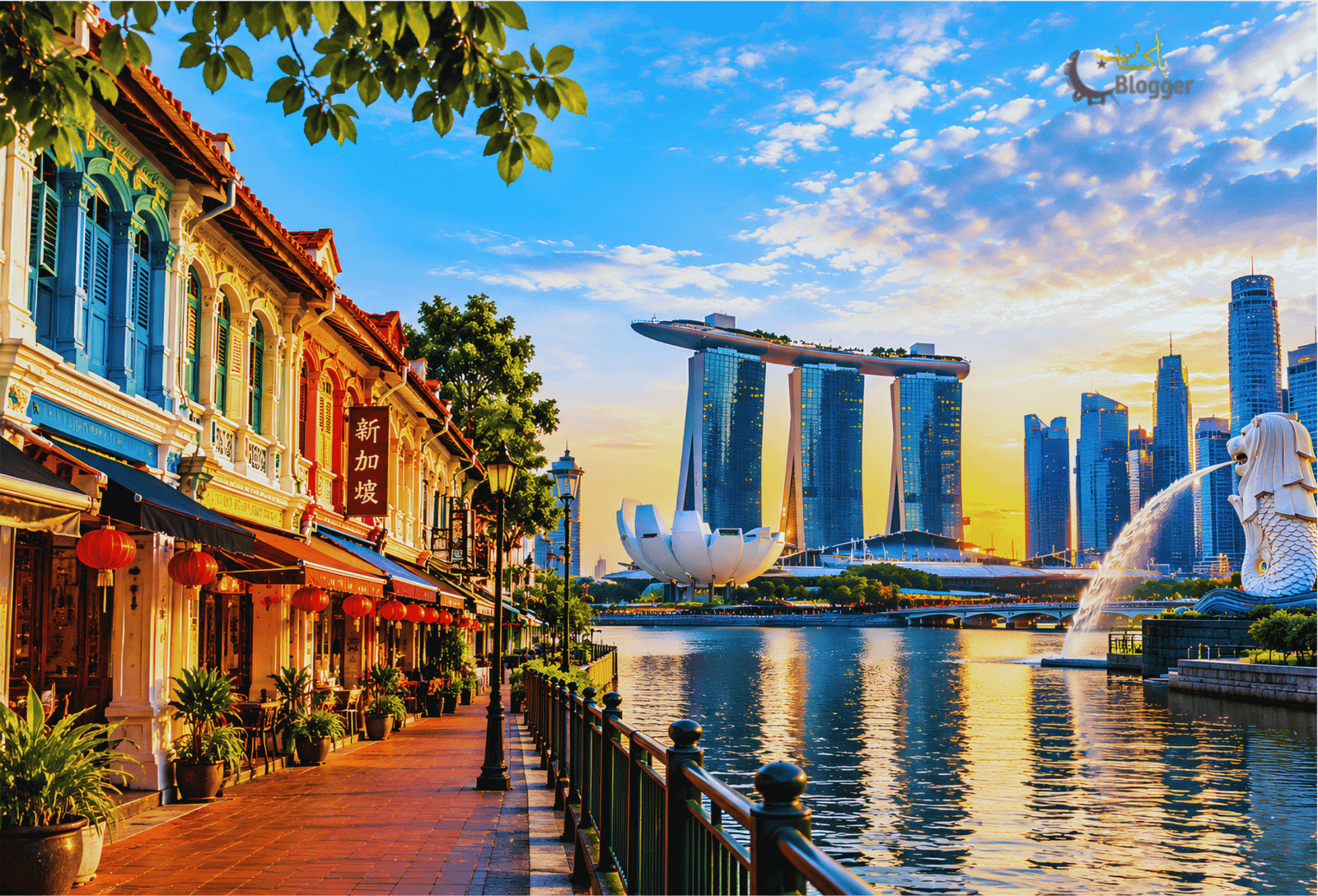
The Merlion is one of the first landmarks many visitors think of when visiting Singapore.
The Merlion is a lion’s head on a fish’s body. It is designed to link together two significant aspects of Singapore’s identity.
The Singapura legend is called the lion’s head. The fish symbolizes Singapore’s historic ties to the sea and of being a former fishing village.
The outcome is a unique symbol, which connects the traditional story and the maritime heritage of the country.
Where Can You See the Merlion?
One of Singapore’s most popular sightseeing spots is Merlion Park, near Marina Bay.
There is a spot for visitors to take a photo of the statue and the skyline of the city. The area is also surrounded by notable buildings and attractions.
The park is especially sought after by people who are new to the nation since it is a familiar national emblem in the midst of the city.
Best time to visit is early in the morning or late in the evening. It may be more pleasant temperatures and beautiful lighting during these times, but it is not guaranteed.
What Makes the Merlion Special?
The Merlion is more than just a decoration monument. It offers a simple and visually borne explanation of the connection of Singapore’s name, history, and maritime geography.
The symbol is also indicative of the reinterpretation of the city’s history for modern audiences.
It is not necessary to be very knowledgeable of the history to enjoy it in its design. But if you have an understanding of the meaning, it is more rewarding.
The Merlion is a good beginning to the broader tale of Lion City Singapore.
Best Places to Discover Singapore’s Historical Heritage
To see the heritage of Singapore, one must visit sites that are linked to its early settlers, colonial era, and cultural communities.
Other attractions offer other views on the development of the city.
1. Fort Canning Hill
Fort Canning Hill is one of the most historic places in Singapore.
Early settlement, Malay royal traditions, colonial administration and military history are associated with the hill.
It can be visited today to enjoy its green spaces, historical aspects and archaeology.
Convenient to tourists who want to learn more about the history of Singapore, it is located in a prime area close to the city centre.
2. Merlion Park
The Merlion is a link between the Lion City and the modern waterfront of Singapore.
The statue is a great way to get more information about the meaning of the country’s name and gain some views of Marina Bay.
Visitors are also able to see the stop in conjunction with walks along the waterfront and other central sights.
3. Chinatown
Chinatown is a testimony of the impact of the Chinese communities on the growth of Singapore.
It has traditional shophouses, temples, food shops and cultural attractions on its streets.
Visitors can learn about the impact migration, trade and family businesses had on the development of the city.
The district is also beneficial for its insight into the multicultural nature of Singapore.
4. Kampong Gelam
Kampong Gelam is very much linked to Malay heritage and Singapore’s historical Muslim community.
The district features the Sultan Mosque, traditional businesses, and the streets that bear elements of cultural identity.
There are opportunities to learn about architecture, the local food, textiles, and modern creative areas.
The site illustrates the potential of heritage districts to be vibrant, contemporary urban neighbourhoods.
5. Little India
Little India is another viewpoint of Singapore’s multicultural past.
It has a Hindu temple on its streets, traditional stores, colourful buildings and companies serving the local residents and visitors.
Examine the district and discover the impact of Indian migration, religion, food and trade.
It also highlights the contribution of various cultural communities to a common national identity.
6. The National Museum of Singapore
The National Museum of Singapore offers a more general overview of Singapore’s history.
The historical, cultural and personal journeys that helped shape Singapore are presented in its exhibitions.
The museum is especially useful for visitors who want more background information before they go exploring around the city.
It also contributes to the overall historical narrative of the struggle for independence and modernisation, and links the Lion City of the past with the present.
7. The Former Ford Factory
Former Ford Factory is a significant location that has a connection with the British surrender in 1942.
It has exhibits on the Japanese occupation and the lives of people during the war years in Singapore.
The site offers a greater insight into the tribulations of the country’s recent past.
It is particularly useful for tourists wishing to go beyond the typical tourist tour.
Hidden Heritage Experiences Beyond the Famous Attractions
The historical charm of Singapore doesn’t end with its iconic structures.
While there are well-visited sites like the Merlion and the Marina Bay, there are smaller sites that can offer a more intimate connection with the city’s history.
Explore Traditional Shop houses
In the conventional shophouses, business premises and architectural elements from various historical periods are integrated.
Examples of these can be seen throughout many heritage areas.
They are characterized by their narrow plots, unique designs and decoration of the facades, which express the process of urban life.
The neighborhoods can be walked through so that visitors can see the details that they may not notice if they were not there.
Visit Historical Religious Buildings
The religious buildings in Singapore reflect the diverse religious community and long history of cultural exchange in Singapore.
Often mosques, temples, churches and other houses of worship are located within a relatively short distance of each other.
The architecture and ongoing use of them indicate the religious practices as integral to daily life.
Respect local customs, dress appropriately and follow local photography restrictions if applicable.
Discover Singapore’s Maritime Connections
Sea has always played an important role in Singapore’s development.
It facilitated regional communities with overseas markets and its port promoted migration and urban growth.
Visitors who are interested in this history can visit the various waterfront locations and museums, which will explain shipping, trade and the evolution of the island’s economy.
The experiences are a welcome contrast to the city’s contemporary business landscape.
How Singapore Balances Tradition and Modern Development
At first, the Singapore’s modern appearance may make the sense of its historical character less apparent.
But, the heritage conservation can still be seen in the restored neighbourhoods, museums, public monuments and protected buildings.
Preserving Heritage in a Changing City
Historic buildings and established communities have opportunities and challenges associated with urban development.
A few buildings and neighbourhoods have been retained whereas others have been modified for contemporary use in Singapore.
Shop houses, conservation districts and cultural institutions help to connect with past eras.
These also help to promote tourism as a source of livelihoods other than shopping centres.
A Multicultural Society
The official language in Singapore is English, Malay, Mandarin Chinese and Tamil.
For many public and professional interactions, the main language of communication is English. The other official languages reflect important cultural and historical connections in the meantime.
The country’s pride in its national flag, its cultural celebrations, food heritage and cultural districts add to its value as a nation.
This multicultural context is what helps to account for Singapore’s history as more than one community and legend.
Instead, it evolved as a number of overlapping stories.
Interesting Facts About Lion City Singapore
Singapore’s history and identity are of special interest for several reasons.
The name of Singapore comes from Sanskrit. Singapura is made up of words normally interpreted as lion and city.Singapore is not the native habitat of lions. The animal of the traditional founding legend is not clear.
The name Temasek was the name used earlier. This name is linked to historical traditions of the island before Singapore had become an established community.
Singapore is strategically located with respect to the sea. It has been commercially important due to its close proximity to the Strait of Malacca.
The Merlion is made up of two symbols. The lion head symbolizes the story of its founding and the fish body its connections with the sea.
Singapore became independent in 1965. After an short stint in Malaysian hands, Independence was gained.
The island has a multicultural heritage. It has been influenced by Chinese, Malay, Indian and other communities.
Fort Canning Hill is an historical link. The site provides information on Singapore’s early settlement and later colonial history.
Singapore is a city, as well as a state. It’s a small country in a small size compared to other countries.
The Lion City name is still widely known in the world. It ties together a myth from centuries past and Singapore’s contemporary standing in the international spotlight.
These facts demonstrate the influence of geography, cultural interaction and history on the development of the nation.
Practical Travel Tips for Exploring Singapore’s Heritage
There is no need to make visitors’ trips to Singapore complicated to discover the historical attractions.
With a little planning, you’ll be able to pair up some of the city’s iconic landmarks and some of its lesser-known cultural landmarks.
Choose the Right Time to Explore
Singapore has a tropical climate and hence the temperature and humidity can be high all year round.
Walking through heritage districts is usually easier in the morning.
Showers also are possible, so a compact umbrella may be useful.
Look at the latest forecasts before undertaking longer outdoor activities.
Use Public Transportation
Many major attractions and heritage neighbourhoods are connected to the public transport system in Singapore.
Traveling between central landmarks without renting a car can be easier with the use of the MRT and local buses.
Before departing from the place you are staying, review routes, service information and fare information.
This can save you time and make your sightseeing easier.
Combine Nearby Attractions
Neighborhood group attractions help to reduce unnecessary travel.
For instance, you can visit Merlion Park and other Marina Bay attractions in one trip.
An alternative route might be Chinatown and other main cultural destinations of the city.
Fort Canning Hill is a site that can be enjoyed in a day of historical sights.
Take time to visit each site, instead of rushing from landmark to landmark.
Respect Local Culture
One of the interesting aspects of Singapore is its cultural diversity.
Adhere to dress code and photography guidelines for religious premises.
Do not disturb worshippers, and always seek permission before taking pictures of people in sensitive locations.
Respecting local customs enhances the enjoyment of the visit of the heritage.
Check Opening Hours and Entry Requirements
The schedule, exhibits and admission fees of museums are subject to change.
Always read the official information of the attractions before visiting them, particularly during their visit to a special exhibition and/or Museums.Also travelers should check up on the visa and entry requirements for their country.
These are some easy ways to avoid unnecessary interruptions.
Why the Lion City Story Still Inspires the World
The Legend of Lion City Singapore carries on its legacy of being a topic of interest in combination with the elements of legend, geography, history, and national identity.
The name was supposedly inspired by a mysterious encounter with an animal and remained unchanged despite political and economic transformations.
Before the modern skyscapers changed the face of the island, its strategic position allowed sailors to trade and exchange ideas.
Singapore went through several stages of development under British colonial rule, Japan’s occupation and Singapore’s independence.
Over a number of years, institution building, economic planning and social change shaped the modern country.Visitors today can discover these various chapters of history in historic districts, museums, monuments and cultural traditions.
Thus the name Lion City is more than just an intriguing historical fact. It provides a usable starting point to the study of a complex and continually changing society.
Conclusion
The best way for travelers to appreciate the area is to look at the mountains beyond the skyline. Discover the areas where Singapore’s maritime history, multicultural societies and contemporary aspirations converge.
That trek offers a glimpse into the reasons why the Lion City is one of the most unique places in Asia.
Read More Blog:
https://bloggerspakistan.com/best-beautiful-places-to-visit-in-2025-ultimate-travel-guide-for-adventure-and-exploration/: Lion City Singapore: Amazing Secrets Behind Its Powerful Name
Frequently Asked Questions About Lion City Singapore
Why is Singapore called Lion City?
Singapore is called the Lion City because its name derives from Singapura, a Sanskrit-derived word commonly translated as City of the Lion. A traditional Malay account connects the name with Prince Sang Nila Utama, who reportedly encountered a lion-like animal on the island.
What does Lion City Singapore mean?
Lion City Singapore refers to the meaning associated with the name Singapura. The word combines elements meaning lion and city. The lion has become a symbol of strength, courage, and national identity.
Did lions ever live in Singapore?
There is no convincing evidence that lions naturally lived in Singapore. The animal described in the traditional founding story may have been a tiger or another creature. However, historians cannot identify it with certainty.
Who named Singapore the Lion City?
According to the Malay Annals, Prince Sang Nila Utama named the settlement Singapura after encountering an animal he believed was a lion. The account remains an important traditional explanation for Singapore’s name.
What was Singapore called before Singapura?
Temasek was an earlier name associated with Singapore. Historical Chinese sources also recorded a name commonly interpreted as Pulau Ujong, meaning the island at the end. These names reflect the island’s earlier geographical and maritime identity.
What is the difference between Singapura and Singapore?
Singapura is the historical name from which the modern name Singapore developed. Both names are associated with the meaning City of the Lion, although Singapore is the internationally recognized modern name.
What does the Merlion represent?
The Merlion has the head of a lion and the body of a fish. Its lion head refers to the Singapura legend, while the fish represents Singapore’s maritime history and earlier fishing settlement.
Where can visitors learn about Singapore’s history?
Visitors can explore Fort Canning Hill, the National Museum of Singapore, Merlion Park, Chinatown, Kampong Gelam, Little India, and the Former Ford Factory. Each location offers a different perspective on Singapore’s historical development.
Is Singapore worth visiting for history and culture?
Yes. Singapore offers museums, historic neighborhoods, religious landmarks, restored shophouses, and maritime attractions. Visitors can combine these experiences with modern architecture, local food, shopping, and waterfront activities.
What is the best place to photograph the Lion City?
Merlion Park is one of the most popular locations for photographing Singapore’s waterfront and skyline. Fort Canning Hill and historic cultural districts also offer interesting settings for visitors interested in heritage and architecture.
Which country is Lion City?
The Singapore is also called the lion city.
Where is Lion City?
The Lion City Singapore is a sovereign island country in Southeast Asia.