



Table of Contents
Interview Warm Up
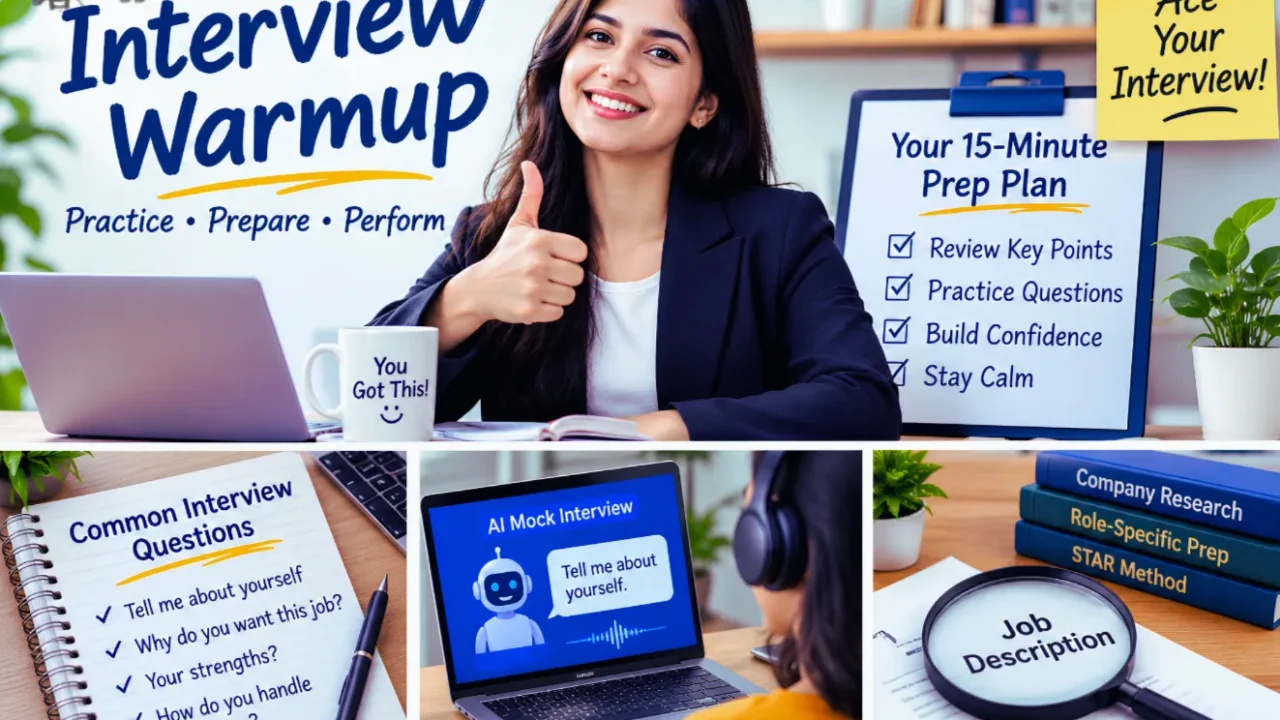
Doing more than memorizing the typical questions and rereading your CV is required for preparing for a job interview. You also have to work on thinking through your ideas, recalling your successes and feeling at ease with telling your story. An efficient interview Warm-ups can actually make a great deal of distinction there. A short preparation helps you concentrate on the position, practice answers, and get more comfortable before you enter the conversation.
A lot of candidates get jittery before the interview even if they have the relevant skills and experience to give. They might have trouble answering basic questions or fail to remember important examples or talk too fast when under pressure. Here’s the great news: You don’t have to spend hours preparing to help improve your performance. You can complete a 15-minute structured session to cover the job description, rehearse your opening, and plan your answers, incorporating the STAR method.
New AI interview practice tools are also easier to use for preparation. Create questions for the job, practice mock interviews, and get feedback on your responses. But technology can’t replace real experience or natural communication.
This guide will help you understand what’s involved in conducting a successful 15-minute warm-up, boost your interview confidence, practice behavioral and technical interview questions, and make good use of AI tools. You will also be able to understand the Google Interview Warm-up, alternatives, common mistakes to avoid, and the last few things you should do before your next job interview. These tips for preparing are useful to both new and seasoned students.
1. What Is an Interview Warm Up and Why Is It Important?
An interview warmup is a brief practice session done just before a job interview. It assists you in organizing your thought and concentration on the role. Rather than cramming all the information, you take a quick glance at the key information, practice some of the responses, and remember the experience and skills that you will be able to talk about. It’s a helpful last step in your overall job interview preparation.
Warmup is not multiple days of interview preparation. Full preparation includes company research, resume preparation, job description review, and understanding the hiring process. An Interview Warm up is intended to make good use of this preparation. You could consider looking at three job requirements, remember two achievements, and rehearse your introduction. This easy exercise will help you build your interview confidence and reduce interview stress without becoming overwhelmed.
Why an Interview Warmup Makes a Difference
Candidates have some answers to common questions but cannot articulate when questioned by an interviewer. A brief practice session aids recall of pertinent information and arranging thoughts. It is also an opportunity to see if your responses come across as spontaneous or scripted.
An interview warm up can also enhance the communication skill. Speaking answers aloud increases your awareness of your rate, vocabulary, and articulation. You’ll be able to spot redundant info and learn how to convey concepts straight. Such minor changes can help make your answers more understandable to an interviewer.
| FULL INTERVIEW PREPARATION | FINAL INTERVIEW WARMUP |
| Takes place over several days | Usually takes 5–15 minutes |
| Includes company and industry research | Reviews the most relevant information |
| Covers a wide range of possible questions | Practices a few important questions |
| Builds knowledge about the role | Helps you recall useful knowledge |
| Includes detailed mock interviews | Focuses on confidence and clear delivery |
It is not about memorizing the correct responses. It’s to remind of what you want to say. Outline your ideas; don’t write everything out. This will help sound professional while maintaining your natural speech.
2. How to Complete an Effective 15-Minute Interview Warmup
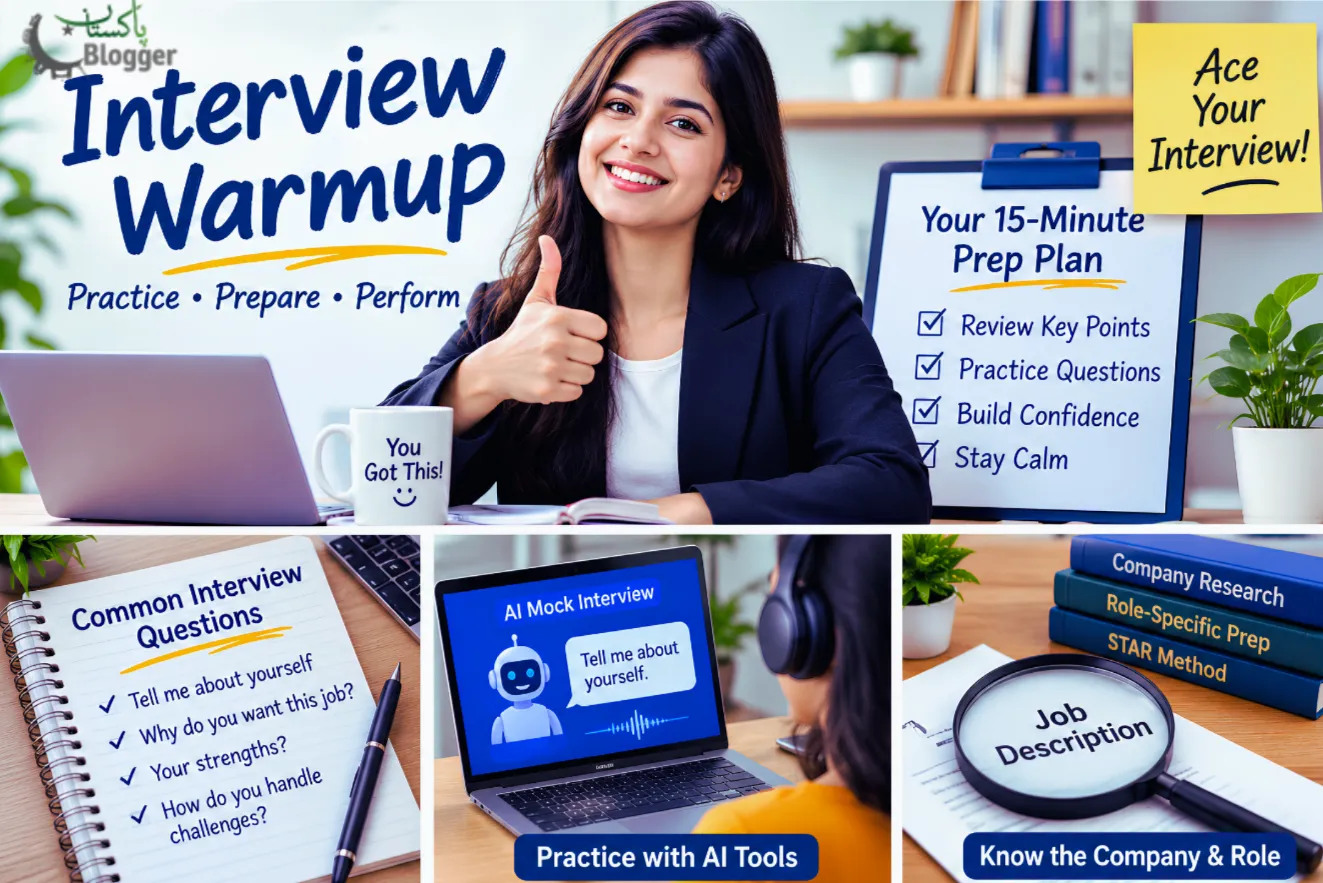
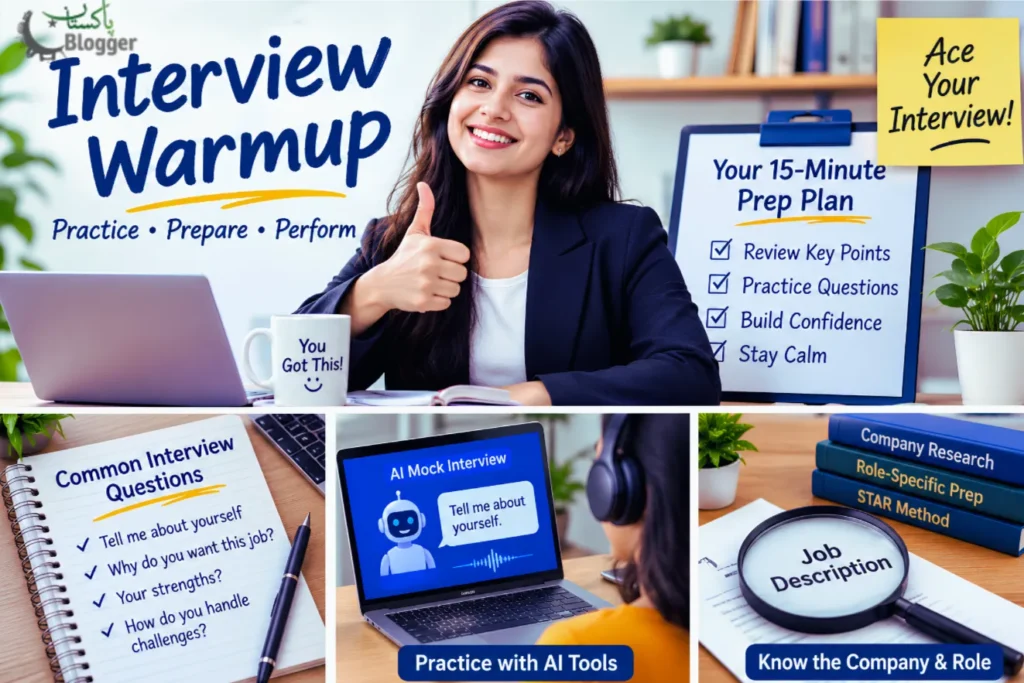
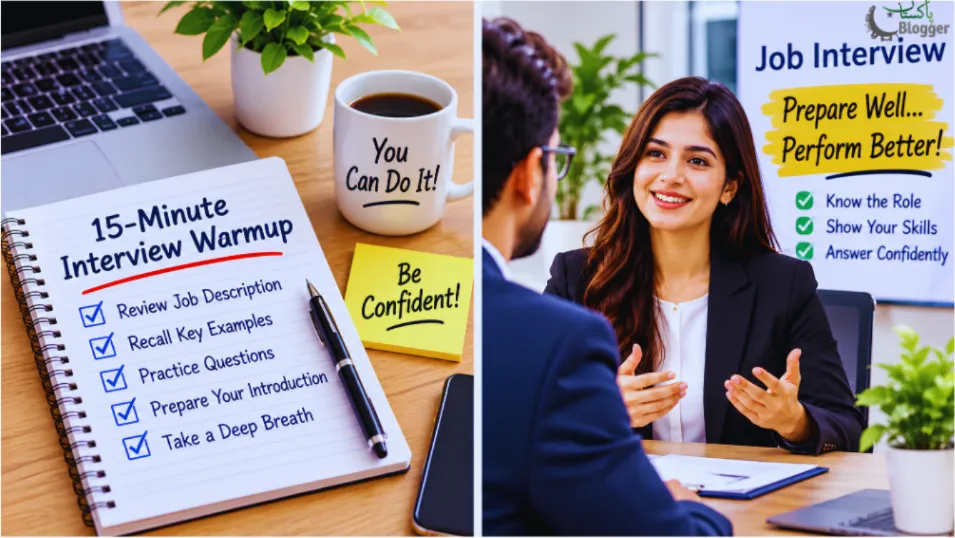
An effective warm-up can take place in 15 minutes by breaking it up into four easy steps. Review the role, remember some examples of it, practice a question, and then ground your mind. This program is suitable for recent graduates, experienced professionals, and individuals making a career change. It also helps to prepare for interviews for those who have no idea how to get started.
An effective warm-up can take place in 15 minutes by breaking it up into four easy steps. Review the role, remember some examples of it, practice a question, and then ground your mind. This program is suitable for recent graduates, experienced professionals, and individuals making a career change. It also helps to prepare for interviews for those who have no idea how to get started.
Your 15-Minute Interview Preparation Routine
| TIME | WHAT TO DO | MAIN PURPOSE |
| Minutes 1–3 | Review the job description and key requirements. | Focus on what the employer needs. |
| Minutes 4–7 | Recall two or three work or study examples. | Prepare evidence of your abilities. |
| Minutes 8–11 | Practice one behavioral or role-specific question. | Organise a clear answer. |
| Minutes 12–15 | Practice your introduction and take a few slow breaths. | Improve focus and confidence. |
For the first 3 minutes, read through the job description to read through the main responsibilities and qualifications. Select 2-3 skills that are most important. For instance, an organization, communication, and time management skills might be required for a project coordinator. Think about situations in which you used those skills. It is not necessary to read the job advert all the way through.
In the next 4 minutes, review examples of your skills. Consider a challenging task, a successful project, a conflict that you resolved, or a deadline that you met. Use one example to organize using the STAR method: Situation, Task, Action, and Result. This technique is useful to explain what has happened, what was needed, what was done, and what was accomplished.
For the minutes 8-11, practice one question about the role. A software developer may talk about how they troubleshoot; a customer service candidate may describe how they deal with an unsatisfied customer. Be on topic and give reasons. Last, but not least, rehearse your introduction for a few minutes, pay attention to the speed of your talking, and relax your shoulders.
A Short Five-Minute Warmup
Use the shorter version if the interviewer makes the last-minute call or has very little time. Review the role x 1 minute, recall an achievement x 2 minutes, rehearse them with the introduction x 1 minute, and practice slow breaths x 1 minute. A short check can help to focus.
Consistency is the key. A simple process that can be repeated to different interviews is more effective than a complicated one that can put pressure on the interviewee. Focus on employer needs and the true experience you have to offer.
3. How to Build Confidence and Improve Your Answers Before an Interview
Being confident doesn’t mean that we never feel nervous. It implies you will be able to convey your message clearly, even if you are feeling some pressure. To develop confidence in the interview, it is important to know your strengths, to have examples to bring up to the interview, and to practice explaining your experience. Many candidates are not used to speaking when they are not preparing for it and find it easier to communicate during an interview than they do if they were preparing for a perfect response.
Firstly, identify the value you can add to the role. It can be from a contribution to a full-time job, an internship, a project in school or college, volunteering, or your own work. State professional strengths and relate to employer needs. This provides your answers with a definite purpose, and you can explain why your background is important.
Prepare Your Introduction and Elevator Pitch
The first most frequently asked question is Tell me about yourself. Your answer should provide a brief introduction to who you are, your experience, and your interest in this position. How to answer the “Tell me about yourself” question can make the initial minutes of an interview less anxiety-inducing. Create an elevator pitch that requires about 45-60 seconds. For instance, someone just out of college might say:
I have recently graduated with a degree in business administration and have had a passion for project coordination and operations throughout my studies, including group projects where I have enhanced my communication and planning abilities. I now seek a role where I can continue to use these skills, gain knowledge from a larger team, and be a part of structured project delivery.
Your introduction should accurately reflect your background. Do not memorize all the words. Be sure to recall the key points and then convey them in a natural way.
Practice Behavioral Questions With the STAR Method
Frequently, companies ask behavioral questions to learn about how you dealt with things in the past. They might ask about cooperation, leadership and management, conflict, problem solving, or working under pressure. Preparation for answering behavioral interview questions provides you with the opportunity to be ready to answer those questions in actual terms, not with generalizations.
The STAR interview answer technique helps to structure your answer to the interview question. Assume that someone asked you in an interview about your experience with a last-minute deadline. You might set up the situation, spell out your role, recap what you did personally, and share the outcome. Use the term sparingly, and instead think of what you did.
Manage Nervousness and Difficult Questions
Interview nerves can impact your focus, rate of speech, and capacity to recall examples. Before the interview, take deep breaths to calm down, relax your shoulders, and remind yourself that this is a professional conversation. It isn’t a requirement to answer all the questions on the spot. Take a break to get thoughts in order.
Be ready to answer tough questions regarding weaknesses, gaps in employment, lack of experience, or past errors. Be honest and tell what you learned or how you improved. If you have had problems managing your time in the past, explain how you planned and the way that it impacted your work. But this is showing self-awareness in a non-excusing way.
| COMMON CONCERN | A MORE CONSTRUCTIVE RESPONSE |
| I do not have enough experience. | Explain relevant projects, training, internships, or transferable skills. |
| I might forget my answers. | Remember key examples rather than memorising full scripts. |
| I feel nervous. | Practice aloud and use slow breathing before the interview. |
| I do not know the answer. | Explain your reasoning and ask for clarification when needed. |
‘
Keep in mind that an answer doesn’t have to be wordy. They require material that is relevant, well organized and honest. These habits will enhance your Problem-solving skills and give the interviewer an idea of how you work.
4. How AI Tools Can Make Your Interview Warmup More Effective
AI tools can help you ease the interview practice process with generating questions, creating scenarios, and reviewing responses. Practicing with an AI mock interview can help you prepare for scenarios relevant to the job you are applying for. AI interview practice can also help you find gaps in your explanations and enhance your answer flow.
But AI is not meant to be a replacement for your judgment, it is meant to aid your preparation. A tool can’t know all the details about your work history, or know what an employer will ask. Utilize its suggestions as practice material rather than checking important information and ensure that all of the examples are based on your own experiences.
Generate Questions From the Job Description
A helpful exercise to practice is to provide an AI with an ad for a job, and then instruct it to come up with pertinent questions. This results in Job description based interview questions which link you with the actual work of the job.
For instance, if a project coordinator is seeking employment for a position that requires them to manage competing timelines, report on progress, and communicate with stakeholders, they could practice questions regarding handling conflicting deadlines, communicating with stakeholders, and solving delays. The tool can generate AI-powered interview questions on behavioural, technical, and situational aspects.
Try this prompt:
Play it as an interviewer – read the job description below and develop five realistic questions, two of which are behavioural, two of which are role-specific, and one of which is problem-solving. Remember to leave the answers blank and make sure you ask one question at a time so I can rehearse my responses.
Use AI for Mock Interviews and Feedback
The AI interview simulator enables you to simulate an interview based on a set of questions. There are some tools that offer text-based practice and others that do voice or video practice. They can be used for online mock interview practice, and repeated as many times as needed to be able to explain their experience comfortably.
Once answered, ask for personalized feedback on relevance, clarity, structure and examples. You can also request AI feedback on your interviews to highlight any extraneous information or indicate areas of opportunity for improvement. For instance, have the tool check for your own contribution and outcome in your STAR response.
A useful prompt is:
Review my interview answer to ensure it is clear, relevant, well structured, and professional to identify what I explained well, what I should improve, and suggest a better structure without adding anything that I have not explained. Make my answer as truthful and honest as possible. Analyze and compare Common Interview Preparation Tools.
Compare Common Interview Preparation Tools
Various platforms can be used for various aspects of the preparation. These can vary in features, availability and cost, so visit their websites to see what is offered before relying on any one service.
| TOOL | HOW IT CAN SUPPORT PREPARATION |
| Chat GPT | Generate questions, practice answers, and review response structure |
| Google Gemini | Help develop questions and practice through available voice features |
| Yoodli | Support speaking practice and communication feedback |
| Huru | Offer structured interview practice features |
| Final Round AI | Provide interview preparation and simulation features |
A few people also discover Gemini Live interview practice for conversational speaking exercises. Availability and capabilities may be subject to change depending on the account, device and region. Likewise, the different online interview practice sites might concentrate on a speaking or question creation focus, or on structured feedback.
Use AI Without Sounding Artificial
Answers created by AI can be polished, but may not be an accurate portrayal of your experience. Avoid memorising them or claiming to have invented them yourself. Rather, you should use these suggestions to enhance your phrasing and structure your thoughts. When using external tools, safeguard personal data; review the privacy policy of any platform to which you are sharing sensitive or other information before sharing documents.
5. Understanding Google Interview Warmup and Its Alternatives
Google Interview Warm up was a free interview practice product that was part of Grow with Google. It assisted the users to practice the questions asked in the job scenario and gave an opportunity to recheck their spoken answers. The tool was able to take the audio of the answers and highlight specific terms or talking points. It provided an opportunity to practice without having to arrange for a role player to do a mock interview with them.
It’s crucial to avoid confusing the old Google product with a typical warm up for an interview. The word is now used to refer to any brief pre-interview drill. The previous official address for the former Google tool has been discontinued and will now redirect to the Grow with Google homepage, as of October 2026. The tool was reportedly retired in April of 2026, but hasn’t been announced by Google.
What the Former Google Interview Warmup Offered
The tool enabled people to answer on career fields and general interview questions. It would transcribe the answers they heard aloud for them and give information on the terms or points mentioned in their answer. Answers would be shown to the user, and they would be able to go back and attempt the questions over and over until they mastered them.
The findings were provided for self-review purposes. They were not an official score on an interview, not an employer’s assessment, and not a signing for work. The tool also could not take the place of preparation based on the specific requirements of an employer or the complete CV of a candidate.
Alternatives to Google Interview Warmup
Interview Warm up with general AI assistants, speaking tools and specialised interview preparation platforms can still be used. Questions can be created from a job ad using ChatGPT and Gemini. Yoodli can be used to practice speaking, and Huru and Final Round AI have features to prepare for interviews. There’s no single method for doing this on each platform, so check what they’re doing now before making a selection.
| ALTERNATIVE | SUITABLE PRACTICE AREA |
| Chat GPT | Custom questions, answer review, and role-based practice |
| Google Gemini | Question development and conversational practice |
| Yoodli | Speaking habits and delivery |
| Huru | Structured interview preparation |
| Final Round AI | Interview simulations and preparation support |
One can also try without a specific platform. Write your responses on your cell phone get a friend or relative to pretend interview you, or use a voice assistant to create questions. The best approach is the one that enables you to clearly communicate your own experience.
6. Common Interview Warmup Mistakes That Can Hurt Your Performance
The aim of a warm up is to make you feel ready, not more nervous. A frequent error is attempting to memorize all the possible answers during the last few minutes. This may result in your answers coming across as robotic and you will be left scratching your head when an interviewer restates a question in different words. Learn a script, not the key examples and main points.
One of the wrong things to do is to conduct too much research on the company just prior to the interview. It is important to do some research on a company before an interview, but the majority of this research should be done before the interview. An important fact of the final warmup is to remind them of the role, the reason for their application, and important facts of the role. Spending too much time reading dozens of reviews and/or unrelated company updates at the last minute can lead you astray from the conversation.
Avoid Last-Minute Over Preparation
Another ineffective strategy is to read a long list of questions without verbalizing. A good answer might be recognized by the reader, but that doesn’t mean a clear explanation can be provided. Do not read, speak your responses in Interview practice. 2 or 3 questions in a short, focused session can be more useful than a hurry-hurry, fifty-question session.
It’s also a good idea to not do an intense mock interview right before the actual one. Detailed Mock interviews are best done early in the process of the interview preparation. Avoid leaving out time to relax, but in the final Interview Warm up, practice a few key questions.
Do Not Ignore Practical Details
A few candidates tend to prioritize the textual aspects of the questions and responses, neglecting the actual interview environment. Having a low battery, weak internet or noise in the room can be cause for excess stress, if a document is missing or is due late. Always verify these information before the last few minutes.
| COMMON MISTAKE | BETTER APPROACH |
| Memorising complete answers | Remember key points and real examples |
| Researching everything at the last minute | Complete company research earlier |
| Reading questions silently | Practise speaking aloud |
| Taking a demanding mock interview just before joining | Keep the final warmup short |
| Ignoring equipment or travel arrangements | Check practical details in advance |
| Trying to learn a new skill immediately before the interview | Review what you already know |
Last but not least, don’t assess your performance prior to the Interview Warm up. You might not be 100% sure, and that is OK. Listen carefully, answer truthfully and explain what you think. Often times, a relaxed attitude is the best way to communicate than trying to memorize things at the last minute.
7. How to Adjust Your Warmup for Different Interview Formats
Not all interviews are conducted in the same way. Whether you’re having a phone interview or a video interview, there’s a distinct requirement for clear speech. Attention to travel and presentation is required at an in-person meeting. Your Interview Warm up should reflect the format, the role and the type of questions you anticipate.
The basic steps are the same, Reflect on the position, provide examples, rehearse your introduction, and review your ideas. But the last few minutes should be tailored to requirements of the interview.
Phone and Video Interviews
In a phone interview, concentrate on the voice and background noises. Find a quiet spot, charge up the phone and have the job posting and a few notes to hand. Speak at a normal rate and do not hurry answering the questions. Your tone and clarity are even more important when working with the interviewer because he can’t see your expressions.
If you have a video interview, test the camera, microphone, speakers, internet connection and meeting link before the interview. Position the camera at eye-level and ensure a clean background and appropriate lighting. Close unnecessary apps and turn off notifications. When talking to the camera, turn the camera to look you and when listening to the camera, turn the camera to look at the screen.
In-Person Interviews
If a face-to-face interview is requested, verify the address, travel and time. Please arrive slightly early to settle in for the meeting. Bring a copy of your CV and other documents requested by the employer. Use proper attire and do not have phones on.
In the last warm up, recap introduction and two relevant achievements. Rehearse all the movements and expressions are not necessary. Making a professional impression can be achieved through a natural greeting, active listening and providing clear answers.
Behavioural, Technical, and Panel Interviews
The behavioural interview sometimes asks you about real-life situations. Do Practice Work on Teamwork, Deadlines, Leadership, Conflict and Errors. Apply STAR to limit each answer to a single point. When asked Situational interview questions, explain how you would take action to deal with a potential problem in the workplace and why.
Technical interviews call for a different focus. Engage in review of key concepts, tools, projects and methods concerning the role. Practice explaining your reasoning rather than simply giving a final answer. Students, who are interested in coding, engineering, finance, or data will find this to be a great option.
The number of interviewers in a panel interview is more than one. Pay attention to each question, give the response directly to the questioner, and involve other members of the panel by making natural eye contact. Organise your answer in a logical way to ensure that everyone can follow the explanation you provide.
| INTERVIEW FORMAT | MAIN WARMUP FOCUS |
| Phone | Clear speech, quiet surroundings, and notes |
| Video | Camera, microphone, internet, and eye contact |
| In-person | Travel, documents, professional greeting, and posture |
| Behavioural | Real examples and the STAR method |
| Situational | Practical judgment and decision-making |
| Technical | Role knowledge and problem-solving |
| Panel | Concise answers and communication with several people |
If the interview is a mixed format interview, then merge the appropriate preparation steps. For instance, if you are interviewing for a technical position, it may be a video interview that needs to be reviewed, as well as having to pass a camera and microphone test. Select the appropriate warm-up for the interview.
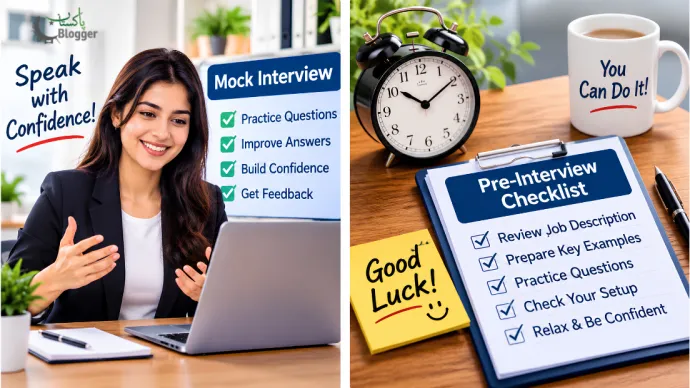
8. Your Final Pre-Interview Checklist: What to Do Before You Join
The last few minutes prior to an interview should help you focus on the upcoming discussion. Read through the most critical expectations, remember the best examples and ensure you will be on time. Avoid using this time to research as much as you can about the company or reword your introduction. Consider what you want the employer to remember.
You should be able to tell your interviewer who you are, what your applicable skills are, and why the position is appealing. It’s also important to have a few questions that you think of to ask an interviewer, as an interview is a chance for both parties to figure out if you are a good fit for the job.
Review Your Answers and Practical Arrangements
Review your introduction and examples of your strengths before you join. Review the interview format and ensure that you have all the necessary items. If you’re interviewing remotely, check your device, connection, camera, microphone and meeting link. If the meeting is to be held in person: telephone your route, arrival time, documents, and contact information.
Make your notes short and to the point. A few key words will assist in recalling points but full answers read out loud during the conversation can impact the delivery. Listen to the question, take a moment to think, and respond directly.
Prepare Questions for the Interviewer
Careful questions demonstrate thoughtfulness regarding the position. Consider asking questions about employer measures of success in the first 3 months, what are the team’s biggest challenges and business objectives? You may also enquire about training, team make-up or the next steps in the recruitment process.
Pick questions that are significant to you. Don’t ask questions that were already answered by the employer. If the interviewer responds to your questions in the course of the conversation, edit your list instead of repeating your questions.
Your Final 15-Minute Checklist
| TIME BEFORE INTERVIEW | ACTION |
| 15–12 minutes | Review the job description and main responsibilities |
| 12–8 minutes | Recall two or three relevant examples |
| 8–5 minutes | Practise your introduction and one key answer |
| 5–3 minutes | Check your meeting setup or final travel arrangements |
| 3–1 minutes | Take slow breaths and relax your shoulders |
| Final minute | Join the meeting or prepare to enter |
For two or three minutes, check in with your role, remember one achievement, check your connection/documents, and take a few slow breaths. That time can still be utilized to get a clearer focus.
Then jot down a few notes on the questions, your responses and what you might do better next time after the interview. Send a professional Interview follow-up email or thank you message, if appropriate, within a reasonable time. Thanks to the interviewer, explains the job, and refreshes the interest in the position with a brief statement. Knowing of How to write a thank-you email after an interview is also a helpful part of what to do after a job interview.
Final Thoughts Make Every Interview Warm up Count
The key to a successful interview is not to memories the right responses. It requires an understanding of the role, an awareness of strengths and good communication skills to relay experience clearly. If you can, a well-designed warm-up can help you get these things in place before you begin a conversation. Start with the 15 minute routine.
Look at the job description, practice some related questions, remember some practical examples and confirm the practical aspects. If AI tools help with the practice, use them but try to answer the question with your own voice. Most importantly, let yourself breathe and concentrate.
At least one thing is learned from each interview. Afterwards, check your performance, update your Job application tracker and identify areas which you did well and where you can improve. After a few practice sessions and a sense of calm, you can improve your communication, overcome nervousness and head into your next interview with a more clear sense of purpose.
Read More Blogs
Frequently Asked Questions About Interview Warmup
How long should an interview warmup take?
An effective Interview Warmup is typically 10-15 minutes long. Be sure to review the job description, practice some answers, and chill out before the interview.
What should you do 15 minutes before a job interview?
Go through the key job requirements, remember the top 2-3 achievements and rehearse your introduction. Look at your setup for the interview and take a couple of deep breaths.
Should you practice answers immediately before an interview?
Yes. Read a few key questions and try to answer them verbatim, but don’t memorize whole answers. Practice clear, natural communication
Can AI tools help with interview practice?
Yes. Chat GPT and its counterpart Gemini can generate interview questions, do a mock interview, and give feedback to help refine the answers.
What is the difference between interview preparation and an interview warmup?
Interview preparation consists of researching the company, resume review and rehearsal over several days. The last warm up before an interview.
Is Google’s Interview Warmup tool still available?
The old web address for Google’s former Interview Warmup tool has been redirected to Grow with Google resources. There have been third-party reports that it has retired, but not a formal announcement from Google.
How can you calm your nerves before an interview?
Breathe slowly, relax shoulders and remind yourself of your professional assets. Practicing your introduction can also help you to avoid interview jitters.
How do you use Google Interview Warmup for free?
What is now known as Google Interview Warmup was a free practice platform for users to read questions and listen to their answers, review transcripts, and learn about their performance. The old tool is no longer available, but you can find out about interview tips and other career resources with Grow with Google.
How can you prepare for an interview with Grow with Google?
Use Grow with Google’s career resources to learn interview tips, get mock interviews, and resume advice. Google Career Certificate students can also use other resources to help with their job search.
Is Google Interview Warmup free?
Yes, the Google Interview Warmup was available for free. But, its old practice interface is no longer available at its old address.